
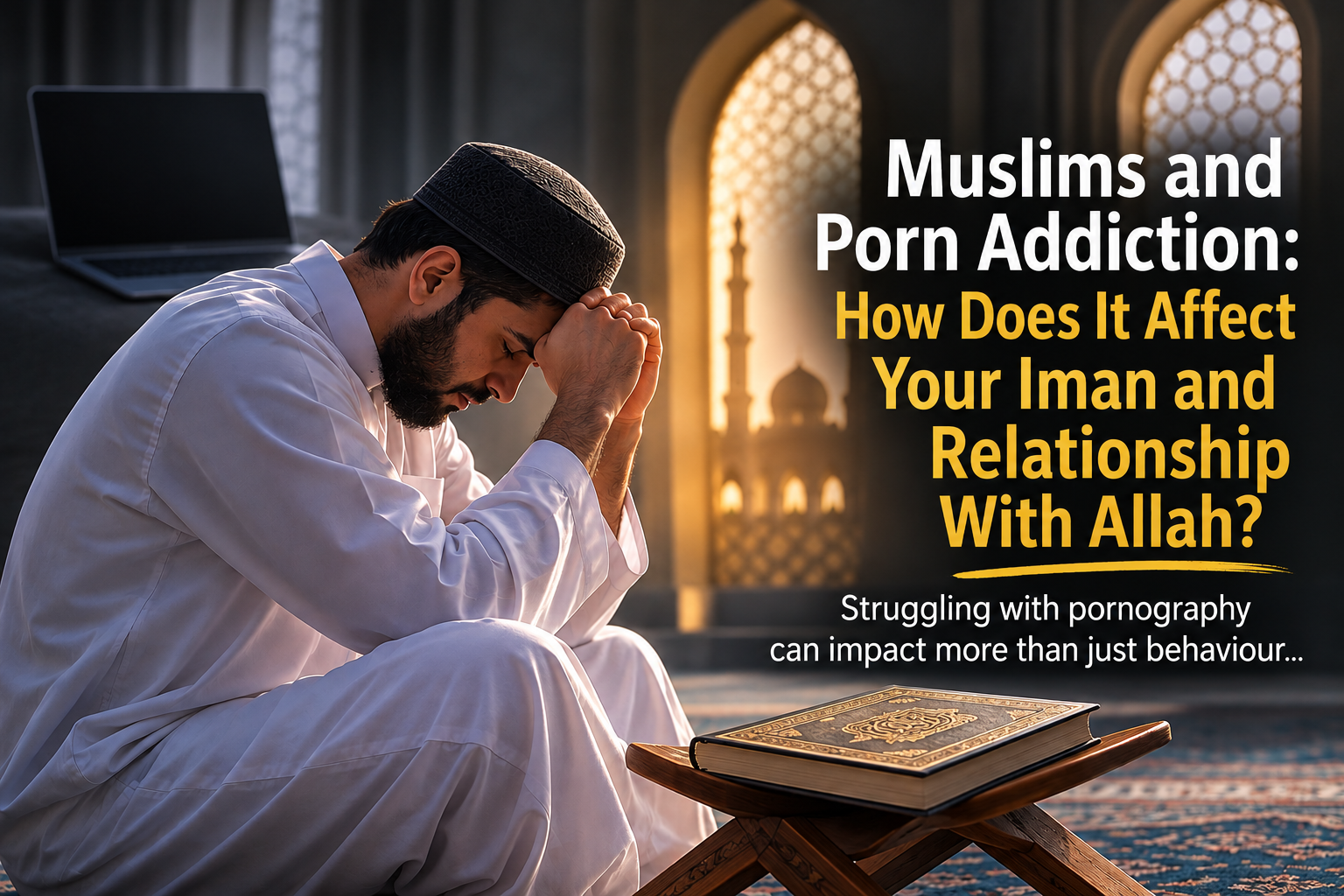
When we talk about pornography addiction, we often focus on the behaviour itself. We talk about the difficulty of stopping, managing urges, avoiding triggers and trying to break the cycle.
But there is another side to this struggle that I think deserves more attention, particularly within Muslim communities.
What does pornography addiction do to a Muslim's spirituality and iman?
For many Muslim men, this struggle goes beyond watching pornography. It can affect how they see themselves as Muslims, how they approach their salah and how connected they feel to Allah.
They might genuinely want to become better Muslims. They want to strengthen their iman, get closer to Allah and live according to their Islamic values.
Yet, behind closed doors, they find themselves returning to a behaviour that goes against everything they believe in.
This can create a lot of internal conflict.
So let's explore some of the ways pornography addiction can affect a Muslim's spiritual wellbeing.
1. The Conflict Between What You Believe and What You Do
One of the biggest struggles for a Muslim watching pornography is knowing that what they are doing goes against their Islamic values.
We know that Allah has instructed believing men to lower their gaze and guard their chastity.
In Surah An-Nur, verse 30, Allah says:
"And tell the believing men to lower their gaze and guard their chastity. That is purer for them. Surely Allah is All-Aware of what they do."
For someone struggling with pornography, this creates an internal battle.
You know what Allah has commanded you to do, and you genuinely want to follow it. But you find yourself repeatedly doing something that contradicts those teachings.
You might ask yourself:
Why do I keep going back to this?
Why can't I control my desires?
Why do I keep making promises to Allah, only to break them?
I think this is something many Muslim men can relate to.
But we need to understand that struggling with a particular sin doesn't mean you don't care about your religion or that you have no desire to become a better Muslim.
You can genuinely want to change and still struggle with certain behaviours.
The important thing is recognising that something needs to change and taking the necessary steps towards that change.
2. The Cycle of Guilt and Shame
Something I think we need to talk about more is the amount of guilt and shame Muslim men experience after watching pornography.
Think about what happens.
You watch pornography, and afterwards you feel terrible about yourself. You regret what you've done, make promises that you won't do it again and perhaps even make sincere dua asking Allah for forgiveness.
You might go a few days or weeks without watching it.
Then, for whatever reason, you find yourself returning to the same behaviour.
And the cycle starts all over again.
Over time, this can become mentally and emotionally exhausting.
Some men start questioning themselves. They begin to feel that they are not good enough Muslims or that they are constantly disappointing Allah.
But I think we need to make an important distinction here.
There is a difference between recognising that you've done something wrong and allowing that mistake to define who you are.
Feeling guilty can encourage you to take responsibility and make changes. But when guilt turns into overwhelming shame, it can make you feel hopeless and convince you that you will never change.
Islam teaches us to seek forgiveness and never lose hope in Allah's mercy.
In Surah Az-Zumar, verse 53, Allah says:
"Do not lose hope in Allah's mercy, for Allah certainly forgives all sins."
This is something every Muslim struggling with pornography needs to remember.
Don't allow your mistakes to convince you that you cannot return to Allah.
Keep making tawbah, keep trying and, importantly, start looking at what you need to change to break the cycle.
3. How Does It Affect Your Salah?
Another area worth discussing is the impact pornography can have on someone's relationship with salah.
Some Muslim men experience feelings of guilt after watching pornography and find themselves struggling to concentrate during prayer.
Others might start delaying their salah or feel spiritually disconnected when they stand before Allah.
They might even question their own sincerity.
But here's something I want to make clear.
You shouldn't allow your struggle with pornography to become a reason to distance yourself from salah.
Salah isn't something reserved for Muslims who never make mistakes.
We all have shortcomings, and we all need Allah's guidance and forgiveness.
In fact, when you're struggling, maintaining your salah becomes even more important.
Allah says in Surah Al-Ankabut, verse 45:
"Surely prayer restrains one from shameful and evil acts."
Rather than allowing guilt to push you away from your prayers, use it as a reason to strengthen your connection with Allah.
Don't wait until you feel like you've become a perfect Muslim before you start taking your salah seriously.
Keep showing up.
4. Feeling Spiritually Disconnected
Have you ever noticed that when you're struggling with something, you sometimes feel less motivated to engage in your religious practices?
You might find it harder to concentrate when reading the Quran. You might not feel the same connection when making dua or engaging in dhikr.
Some men describe this as feeling spiritually numb.
It's important to recognise that there can be many reasons for feeling this way, but repeatedly engaging in behaviour that conflicts with your values can contribute to feelings of spiritual disconnection.
And this is where I think we need to look at recovery differently.
It's not just about removing pornography from your life.
It's also about looking at what you're replacing it with.
Are you building healthier habits?
Are you spending more time engaging in beneficial activities?
Are you making an effort to strengthen your relationship with Allah?
Are you addressing the situations and emotions that make you vulnerable to pornography?
We need to understand that recovery involves changing more than just one behaviour.
It involves looking at our routines, habits, thought patterns and the way we respond to different situations.
5. Don't Lose Hope in Allah's Mercy
I think this is probably one of the most important things to discuss.
Some Muslim men have struggled with pornography for years.
They've tried stopping countless times. They've made tawbah, promised themselves they would change and then found themselves falling back into the same behaviour.
Eventually, they might start thinking:
What's the point? I've asked Allah for forgiveness so many times.
I'll probably just end up doing it again.
I'm not a good Muslim.
These thoughts can become incredibly damaging.
We need to remember that Islam doesn't teach us to give up on ourselves because we've made mistakes repeatedly.
We are encouraged to keep seeking forgiveness and returning to Allah.
This doesn't mean taking our sins lightly or becoming comfortable with them.
It means understanding that we should never allow our shortcomings to make us despair of Allah's mercy.
If you've fallen into the same behaviour again, take responsibility, make sincere tawbah and look at what you can do differently moving forward.
Don't use a setback as an excuse to abandon your efforts.
Keep trying.
6. So, What Can You Actually Do to Rebuild Your Spirituality?
If you're struggling with pornography, I think there are a few areas you should start focusing on.
Start with your salah.
Make an effort to establish your five daily prayers. Don't allow feelings of guilt to push you away from them.
Build a relationship with the Quran.
You don't have to start by reading huge amounts. Even a small amount every day, with an effort to understand what you're reading, can help you reconnect with the Quran.
Make dua and seek forgiveness.
Be honest with Allah about your struggles. Ask Him for guidance, strength and forgiveness. Don't lose hope.
Understand your triggers.
This is something I believe is extremely important.
Ask yourself what usually happens before you engage in pornography.
Are you bored? Lonely? Stressed? Spending too much time alone? Scrolling through social media?
Understanding these patterns can help you identify where you need to make changes.
Start building healthier habits.
Look at how you're spending your time. Introduce activities that give your day more structure and purpose.
This could include exercise, spending time with family, attending the masjid, learning something new or developing beneficial routines.
Don't be afraid to seek support.
You don't have to figure everything out on your own. Speaking to someone who understands compulsive behaviours and recovery can help you develop practical strategies and work towards lasting change.
Spiritual guidance and practical recovery support can work alongside one another.
7. Recovery Is About More Than Just Stopping Pornography
I think one of the biggest mistakes we make when approaching pornography addiction is focusing entirely on stopping the behaviour.
Of course, stopping pornography is important.
But have we actually taken the time to understand why we keep returning to it?
Have we identified our triggers?
Have we learned how to manage urges?
Have we developed healthier ways of dealing with stress, boredom and loneliness?
Have we changed the habits and routines that previously contributed to the behaviour?
These are all important questions.
Because if we only focus on telling ourselves to stop, without understanding the patterns behind the behaviour, we can end up repeating the same cycle.
For Muslim men, recovery should also involve looking at how we can strengthen our relationship with Allah and become more aligned with our Islamic values.
It's about working towards becoming a better version of yourself, both personally and spiritually.
And that takes effort, consistency and a willingness to understand yourself.
Final Thoughts
I think we need to have more conversations about the spiritual effects of pornography addiction within our Muslim communities.
There are Muslim men struggling with this behind closed doors. Many feel embarrassed to speak about it, and some genuinely believe that they are the only ones experiencing this struggle.
We need to move beyond simply telling people that pornography is haram and that they should stop.
Muslims already understand that.
What we also need to discuss is why some men keep returning to the behaviour, what makes it difficult to stop and what practical steps they can take to overcome it.
We need to encourage accountability without creating hopelessness.
We need to remind people of the importance of tawbah while also helping them understand the patterns and behaviours they need to address.
And most importantly, we need to remind Muslim men that struggling with pornography doesn't mean they should give up on themselves or their relationship with Allah.
Your struggle doesn't have to define your future. Keep striving, keep seeking Allah's forgiveness and take practical steps towards changing your life.
At Fitrah Revival, this is something I strongly believe in.
Recovery should go beyond telling someone to stop watching pornography. It should involve understanding the behaviour, learning practical strategies to manage urges, building healthier habits and working towards a lifestyle that reflects our Islamic values.
Because ultimately, it's not just about breaking free from pornography.
It's about rebuilding yourself and reconnecting with your fitrah.
Fitrah Revival | From Temptation to Freedom.
Website: https://fitrahrevival.com